• International Community
    Donor Members

    The Haiti Reconstruction Fund (HRF) is a partnership of the Government of Haiti and the international community.
    read more
  • Reconstruction Fund
    Purpose

    The objective of a reconstruction trust fund is to pool international financial assistance in support of the Government’s recovery program and plans and to channel these funds effectively and efficiently into recovery, reconstruction and development activities.
    read more
  • Reconstruction Fund
    Governance

    The Steering Committee (SC) ensures the HRF program is in line with the overall GoH strategy and that the HRF portfolio responds to the needs of the reconstruction program as whole.
    read more
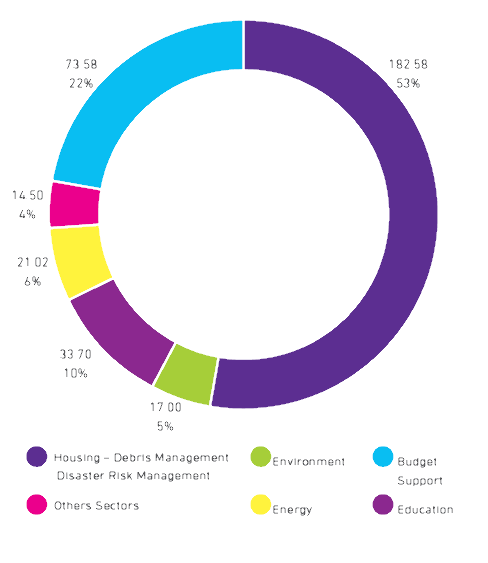
  • The HRF has had a solid first year of accomplishments that included mobilizing over US$350 million for reconstruction finance (or 20% of total reconstruction funds disbursed to Haiti during this period), developing a portfolio of high-quality activities and establishing an efficient mechanism for achieving these tasks. During the course of the first year, an additional US$297 million in contributions were confirmed. 95 percent of donor commitments have been transferred to the Trustee . These results are presented in the HRF Annual Report 2010/2011
    read more

The Haiti Reconstruction Fund (HRF) is a partnership between the international community and the Government of Haiti to help finance post-earthquake reconstruction.  The HRF mobilizes, coordinates and allocates contributions from bilateral and other donors to finance high-priority projects, programs and budget support.  Proponents partner with the Inter-American Development Bank (IDB), the United Nations (UN) or the World Bank (WB) to ensure that international standards for quality, good governance and financial management are met.  All proposals for HRF financing must be endorsed by the Office of the Prime Minister as consistent with the Action Plan for the Recovery and Development of Haiti.

The HRF does not manage all of the resources pledged for rebuilding but is the largest source of un-earmarked financing, having received about 18 percent of total funds disbursed for Haiti as of December 2011.  The HRF does not set reconstruction priorities or directly advise the Government. The Fund does not implement projects but rather works through implementing agencies that are acceptable to one of its three partners. It encourages coordination and the improvement of local capacity while building on each agency/actor’s comparative advantage.

The Fund became effective on May 11, 2010 with an initial contribution by Brazil of US$55 million. As of January 12, 2012, nineteen donors have contributed US$392 million to the Fund. The list of donors and the value of their contributions is expected to increase based on pledges made at the international conferences held in Santo Domingo, New York and Punta Cana. Resources are pooled, and are used for budget support and/or investments aligned with the Action Plan. All donors sign the same Administrative Agreement and no earmarking of funds is allowed.

 Proposals for funding need to comply with the following:

  1. Be endorsed by the Office of the Prime Minister
  2. Be aligned with the Action Plan
  3. Have the technical clearance by at least one of the Fund’s partners (UNDP, IDB, WB, IFC)
  4. Finance one of the three eligible categories of activities: technical cooperation (including capacity building), investment grants or budget support


Proposals are considered on a rolling-basis. No funding cap has been set and there is a fast-track option for urgent requests of less than US$1 million. Decisions for funding are mostly made based on fiduciary criteria. Clearance by one of the partners help ensure technical quality and relevance. Funding decisions are made by a Steering Committee, chaired by the Minister of Finance of Haiti, and comprised of representatives from the Government of Haiti, partners, donor countries contributing with more than US$30 million, and by a representative of the Trustee (the International Development Association - IDA). To ensire a quick response to the government's needs, decisions can be made either virtually or through in person meetings of the Steering Commitee.  The HRF Secretariat is located at the Primature.  See About the HRF for additional information, including the project cycle.